
Case Studies
#1: Post-Acquisition Integration
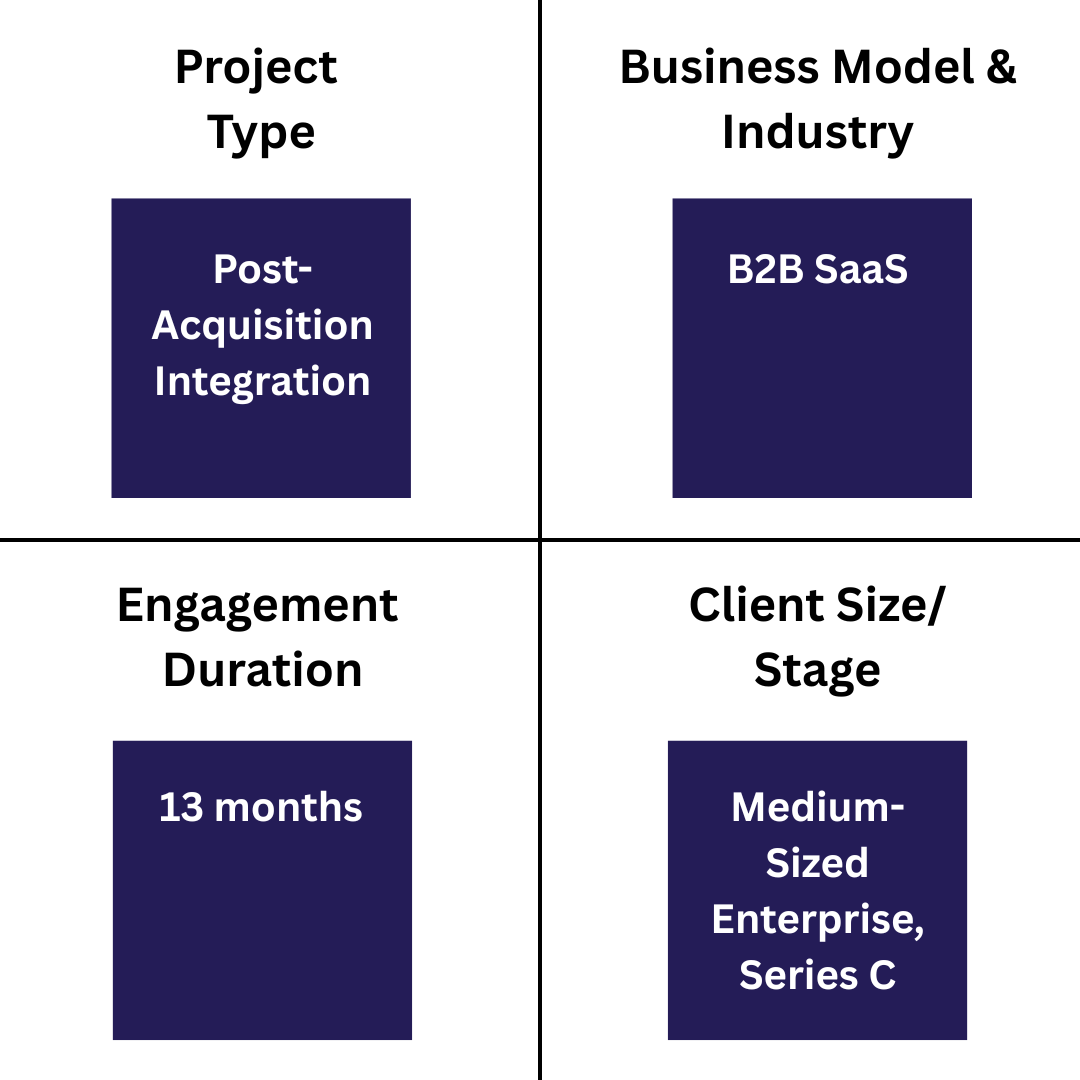
The Problem:
The client had just acquired a competitor with some products that were complementary & some redundant with their pre-existing product suite. Acquired customers fit the client's Ideal Customer Profile to varying degrees. Within the acquired talent, there were some redundancies, some poor cultural fits & some with integral institutional knowledge about the acquired company's products, services, tech stack & customers.
The Action:
Our goal was to define an ideal state post-acquisition, devise a game plan to achieve that state & implement it. To do so, we analyzed:
- Acquired product analytics
- Estimated cross-sell & upsell opportunities across both customer bases & products
- Costs of product upkeep, sales & customer service
- Net lifetime values of all customers
With these analyses, we could determine which:
- Acquired products to maintain, sunset or integrate with the existing product suite
- Customers to maintain & nurture
- Talent to retain/train
Additionally, we designed future state processes & tech stack to accommodate & facilitate those processes, ensuring that the required workflows & data collection of the acquiree were fully incorporated. The work entailed adapting the client's existing tech stack & training the acquiree's employees.
The Results:
The team achieved 80% of our projected upsell & cross-sell opportunities. We cut 25% of the acquired company's costs by sunsetting products with low projected ROI for the future merged company & by letting go of acquired talent with redundant skillsets or poor cultural fit. Rachel led the integration of the product suites & tech stacks within her projected timeframe. By following her workforce integration recommendations, the client retained 100% of the acquired talent she identified as critical to future Ops.
#2: Process/Tech Stack Overhaul
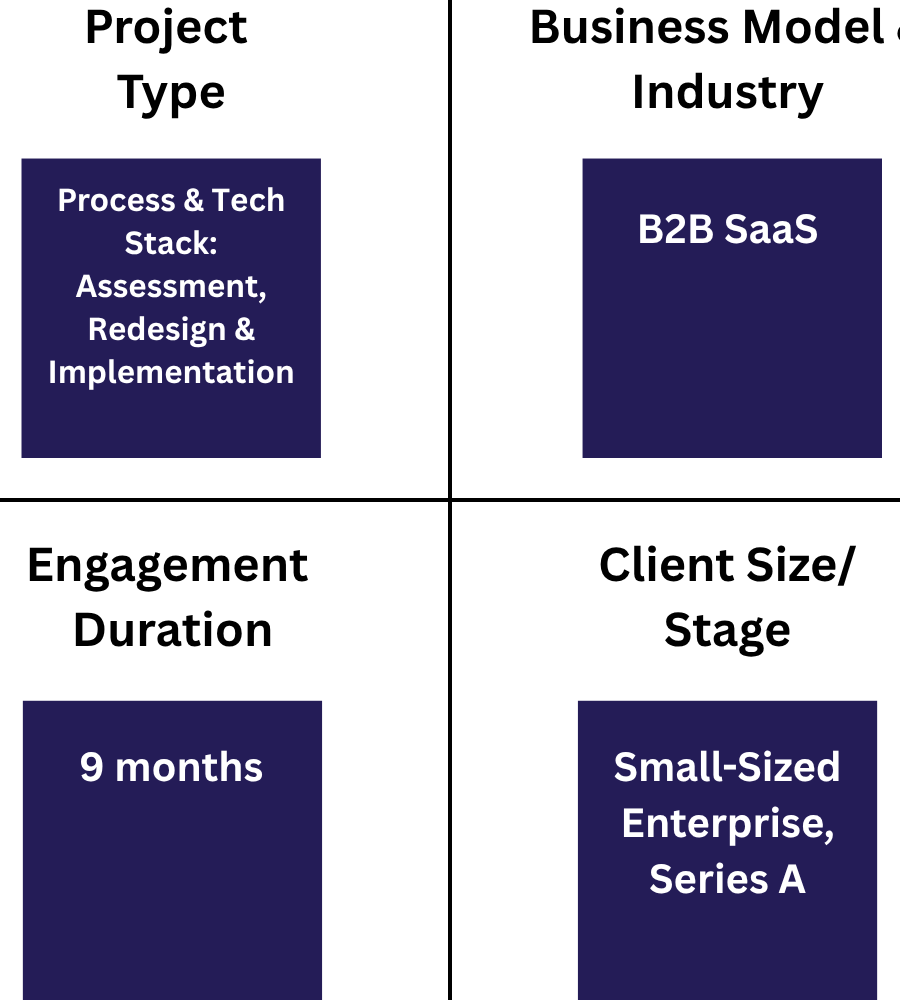
The Problem:
Each functional area within the client's organization was operating in a siloed manner, with inadequate transparency across teams. Processes & tech stacks did not align cross-functionally or facilitate accomplishment of key goals. The resulting issues included unreliable data infrastructure, low conversion rates as leads were transferred from Marketing to Sales, low customer retention due to sub-optimal handoff of new clients from Sales to Customer Service, & frustrated team members.
The Action:
We analyzed all current processes & tech stacks, identifying areas of inefficiency, friction, or redundant or dirty data. Then we designed a future Ops state in which each functional area's processes were fully aligned with one another & designed to enable specific objective achievement on a company & team level. To bring objective achievement front & center, we devised an OKR system that clearly showed the relationships between the targets & goals of individuals, teams & the company, with dashboards showing progress against those targets & projected results. We defined & then implemented an integrated tech stack that facilitated the newly designed processes.
The Results:
Conversion rates across the pipeline increased by an average of 15%, while sales cycles accelerated by 20%. Their client NPS scores went up in lockstep with 15% higher retention rates & increased upsells. Team members reported much less frustration, specifically because of drastically reduced time with data entry/cleaning, not having to chase others down for key information, & generally enjoying a much more effective collaborative environment.
#3: ROIs → Prioritization, Pricing & Positioning
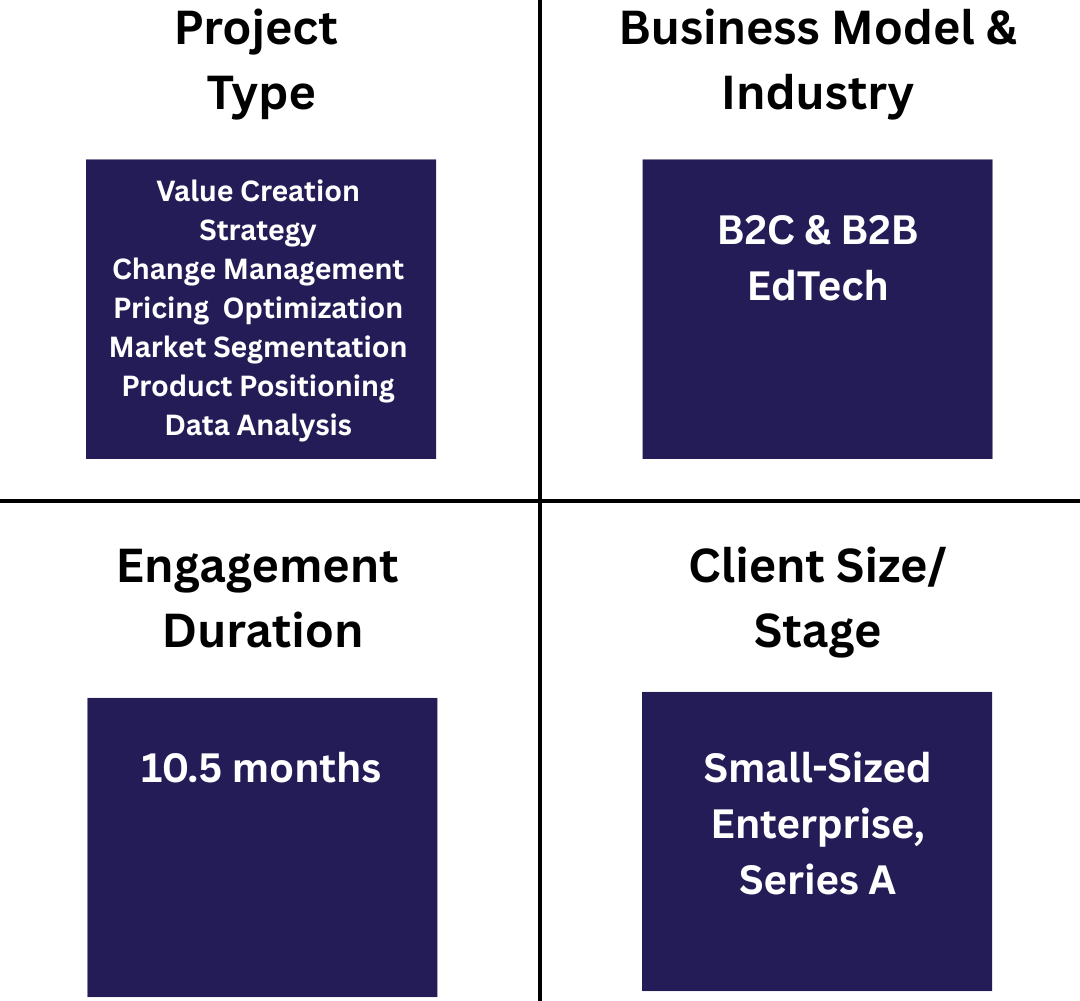
The Problem:
The client had a large & unwieldy suite of products & services, some B2B & some B2C, some with subscription models & some with single purchases, all serving a too-broad array of client types. The overall result was a lack of organizational focus & they needed help identifying the ROIs of their range of activities in order to prioritize, as well as packaging their products & services with appropriate pricing & positioning.
The Action:
We began with customer segmentation of their current customers, pipeline & addressable market to then identify the few most profitable segments they were best equipped to serve with a focused subset of their pre-existing products & services. We then packaged those products & services according to segment type & use case, & proposed an optimized pricing scheme derived through both competitive analysis & analysis of their current products' pricing, margins, usage analytics, renewal rates, & NPS scores.
The Results:
While cutting costs by eliminating or merging some products & services, the client was able to boost revenue by 20% by focusing on the profitable segments with targeted messaging & product packaging/pricing designed for those segments. By thus achieving superior product-market fit, client retention significantly increased as did average deal size.
#4: Data-Driven Product Marketing Strategy
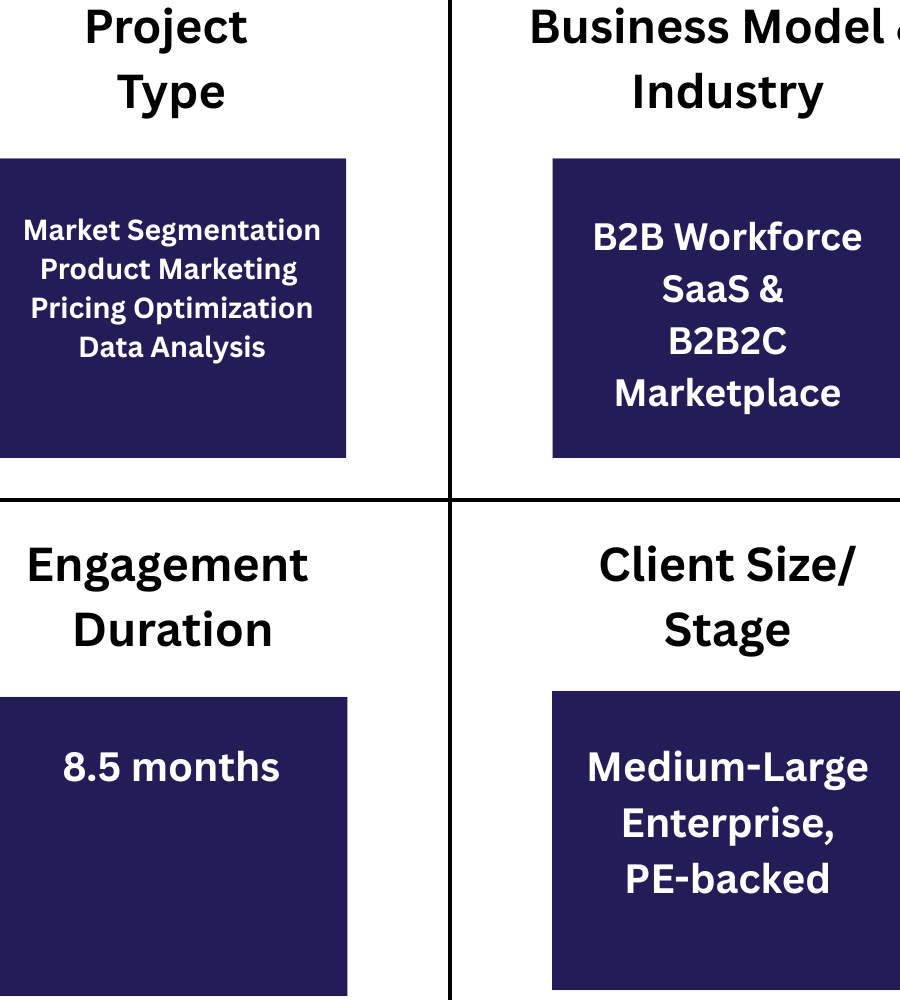
The Problem:
The client's product had multiple features that allowed it to theoretically serve a very wide range of use cases & enterprise clients in different industries. They needed a data-driven strategy to determine which industries & use cases to focus their GTM efforts on, which included a need for new pricing, positioning, & targeting strategy.
The Action:
We mapped out client industry, use case & TAM, as determined by our market research. Through competitive analysis, we determined how saturated each client industry & use case already was with similar solutions, how the client's product was meaningfully differentiated from competitors' & how price points compared. We supplemented this analysis with qualitative data gathered via market interviews with decision makers in considered industries to gauge degree of need & most pressing industry-specific pain point(s). Using a weighted scoring system, we identified which client industries/use cases had the highest potential ROI given our suggested price point. Market interviews informed new product positioning & messaging to most resonate with those client industries' decision-makers.
The Results:
A year after this project, the client reported well above benchmark conversion, renewal, & upsell rates from the client industries we identified as best fit/highest ROI & for whom we developed industry-specific product marketing strategy.